
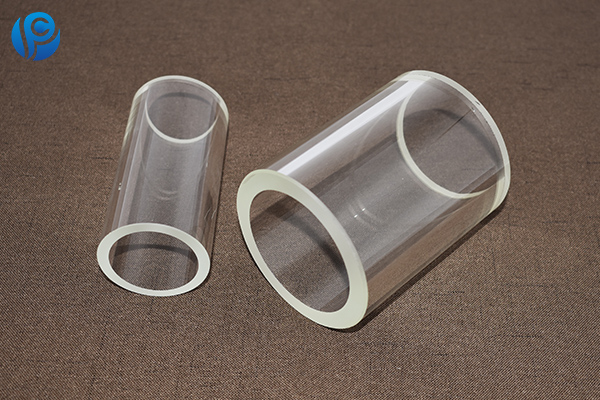
Why Are "Straightness" and "Roundness" So Important for Glass Tubing?

In the world of precision glass manufacturing, straightness and roundness are not merely cosmetic attributes. They are critical geometric tolerances that directly affect the performance, assembly, and reliability of glass tubing in its final application. For industries ranging from medical devices to semiconductor manufacturing, these two parameters can be the difference between a functional product and a failed system.
What Are Straightness and Roundness?
Straightness refers to how closely a glass tube follows a perfectly straight line along its length. A tube with poor straightness will have a visible bow or curve. This is typically measured by placing the tube on a reference surface and measuring the maximum deviation from a straight line.
Roundness (also called circularity) refers to how closely the cross-section of the tube approximates a perfect circle. A tube with poor roundness will have an oval or irregular cross-section. This is measured by comparing the actual cross-sectional profile to a perfect circle.
Why Straightness Matters
Straightness is critical in any application where the tube must fit into a linear assembly or where it interacts with other components along its length. Poor straightness can cause several problems. It can make the tube difficult or impossible to insert into a housing, holder, or connector. It can create uneven contact with seals, leading to leaks. In applications where a fluid or gas flows through the tube, a bowed tube can disturb the flow profile. In optical applications, a bent tube can distort the light path.
For example, in a medical catheter, a tube with poor straightness may not navigate through blood vessels properly. In a flow meter, it can affect measurement accuracy. In a sight glass, it can create stress points when the tube is clamped into place.
Why Roundness Matters
Roundness is equally important for sealing and fitting. A tube with poor roundness will not seal properly with O-rings or gaskets. The sealing element may not compress uniformly, creating leak paths. This is a critical issue in high-pressure or vacuum applications.
Roundness also affects the fit between the tube and any components that slide over it, such as ferrules, septa, or connectors. An out-of-round tube can cause the connection to bind or leak. In fluid handling systems, poor roundness can distort the flow path. In optical applications, an oval cross-section can alter the optical properties of the tube.
Factors That Affect Straightness and Roundness
Several factors during the manufacturing process can affect these tolerances. The drawing process is the most critical stage; any inconsistency in the pulling speed, temperature, or air pressure can cause deviations. Cooling and annealing also affect the final geometry, as uneven cooling can cause warping. Handling and storage are important too, as improper support can cause a tube to sag or bow over time.
Measuring and Specifying These Parameters
Both straightness and roundness are specified as a maximum allowable deviation. For example, straightness might be specified as "0.5 mm per meter" and roundness as "±0.05 mm." These are measured using precision instruments such as laser micrometers, optical comparators, and coordinate measuring machines.
The Bottom Line
Straightness and roundness are fundamental to the function of precision glass tubing. They determine whether a tube will fit, seal, and perform as intended. When specifying glass tubing for a critical application, these geometric tolerances must be carefully considered and clearly communicated to the manufacturer. Failure to control these parameters can lead to assembly problems, leaks, and system failures.

Related articles
- How Are "Striae" and "Bubble" Defects Controlled in O
- Why Do Glass Tubes Need "Flame Polishing" After Cutting?
- What Drawing Parameters Are Required for Custom Quartz Glass
- Why Is Borosilicate Glass Tubing Ideal for Laboratory Use?
- Why Do Custom Glass Products Require Annealing?
- How Are Shaped Glass Tubes Manufactured?
- What Parameters Are Needed for Custom Sight Glass?
- What Are the Key Features of Explosion-Proof Sight Glass?
- Why Chemical Equipment Cannot Do Without Sight Glass
- The Difference Between Transparent and Opaque Quartz Glass

Xinxiang Pan Chao Instruments Co., Ltd.
Tel: +86 13343800331
Contact person:Carrie Niu
Fax: 0373 303 0331
Email:sales@panchaoglass.com
